
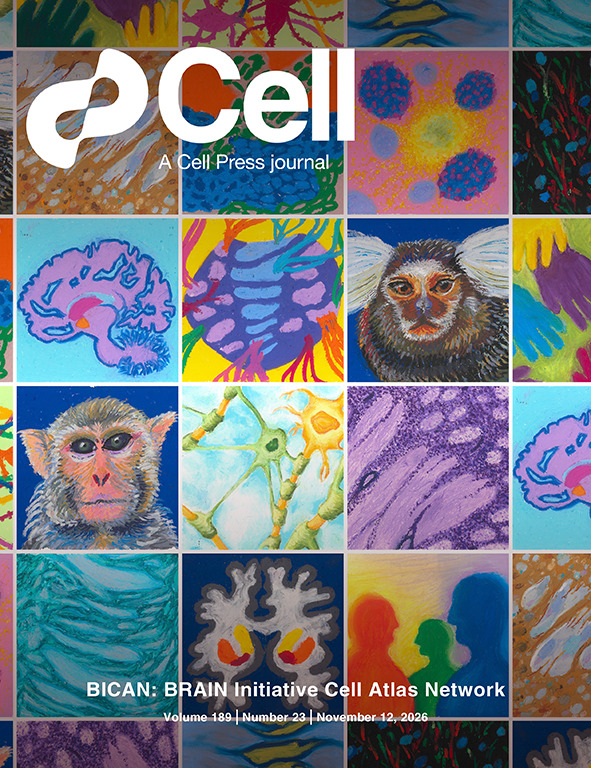
BICAN Basal Ganglia Atlas
The first cross-species multimodal cell atlas of the basal ganglia - subcortical nuclei central to motor control and implicated in Parkinson’s, Huntington’s, and other neurological disorders.
An open, collaborative effort across 55 institutions in 9 countries, with 600+ consortium members — 28 papers spanning Cell, Cell Reports, Cell Reports Methods, Cell Systems, Cell Genomics, and Neuron.
Key findings
Unified cross-species taxonomy
Consensus cell type taxonomy with standardized nomenclature across human, macaque, marmoset, and mouse — resolving conserved types and species-specific molecular divergence.
Mesoscale spatial organization
Spatial transcriptomics reveal dorsolateral–ventromedial gradients, striosome–matrix compartmentalization, molecular zonation, and specialized cellular communities.
Multimodal regulatory architecture
Joint profiling of chromatin accessibility, histone modifications, DNA methylation, 3D genome, and gene expression defines cell-type-specific regulatory programs.
Aging and inter-individual variation
150+ donors reveal thousands of age-associated, cell-type-specific transcriptional changes. Age predictable to ~5 years from any striatal cell type.
Evolutionary conservation and divergence
Major neuronal classes are conserved; primates show expansions and specialization of neuronal and interneuron populations with species-specific regulatory modifications.
Disease applications
The atlas was applied to Alzheimer’s in the caudate, autism-associated disruption in striatal neurons, and enhancer-AAV tools for Parkinson’s models.
Basal Ganglia Resources
Organized by what you want to do — explore cell types, visualize data, navigate anatomy, access raw data, or understand how the data was generated.
The consensus cell type taxonomy — a hierarchical classification of all basal ganglia cell types built by iterative clustering and cross-species integration of snRNA-seq data, with standardized nomenclature and community annotation.
Interactive tools for deeper exploration of epigenomic regulation, multimodal feature integration, cross-species comparison, and differential expression analysis.
Standardized MRI-based 3D spatial references for human, macaque, and marmoset, parcellated with the Harmonized Ontology of the Mammalian Brain Anatomy (HOMBA) cross-species ontology so the same structure names apply across species.
All primary data openly released through NIH BRAIN Initiative archives. Single-cell omics, spatial transcriptomics, imaging, and electrophysiology across three archives plus specimen tracking.
Standardized protocols, sequencing pipelines, and quality control documentation for reproducibility and reuse.
400+ enhancer-AAV vectors from the BRAIN Armamentarium for cell-type-specific targeting. Validated against the consensus taxonomy with cross-species enhancer ranking.